

Skills
Reusable capability modules — the know-how agents draw on to do specialized work
A skill is a packaged set of instructions and know-how — "how to review code", "how to build n8n workflows", "how to process PDFs" — that any agent can draw on. Instead of writing one giant system prompt, agents stay small and pull in skills for the specialized parts. The Skills page (wand icon in the left rail) is the library.
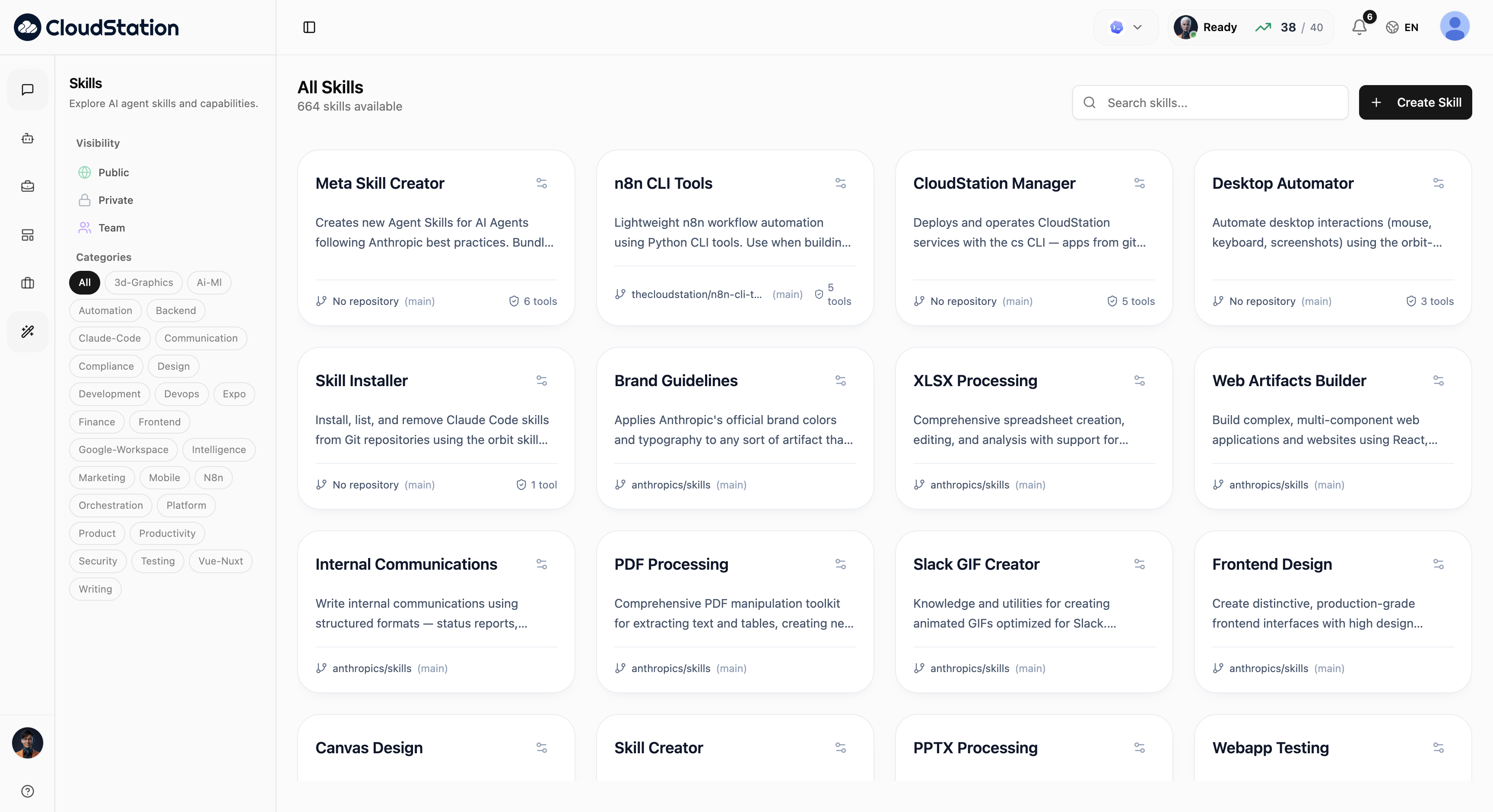
Browsing the library
The library holds hundreds of skills: the public registry (including packs like Anthropic's official skills) plus your private and team-shared ones.
- Search and category filters (Automation, Backend, Design, Devops, Finance, Marketing, Security, Writing, and more) narrow the list.
- Visibility filters split Public, Private, and Team skills — pick a team to see what's shared with it.
- Each card shows the skill's name, what it does, its source repository and branch, and how many tools it uses.
Click a card for the full details: name, visibility, category, status, repository and file path, and the tools the skill is allowed to use.
How skills reach agents
You mostly don't wire skills up by hand:
- Charlie picks them — when Charlie hires or creates an agent in a conversation, it selects the right skills for the job (you'll see a "Charlie is choosing what the teammate needs" card).
- Agent defaults — every agent template carries a Default Skills list; agents you own can have theirs edited in the edit drawer.
- The agent detail page shows which skills an agent carries under Setup → Capabilities.
Visibility
Like agents, skills are Private by default and can be shared with one of your teams — team members then see them under the Team filter. Public skills come from the curated registry.
Skills are versioned from Git: a skill points at a repository, branch, and file path, so its instructions update with its source.
Related pages
- Agents — who uses the skills
- Creating & editing agents — setting an agent's default skills
- Inside a conversation — watching Charlie choose skills during delegation